Some writers guess the future. The five writers on this list did something stranger. They described gadgets, habits, and whole ways of life that did not exist yet, and then watched the real world catch up. One wrote in 1909, before the radio had a voice in most homes. One wrote in 2013, when the smartphone was already in every pocket, and still managed to see further ahead than the rest of us.
This list is not about lucky guesses. A lucky guess is one detail that happens to land. These books got the shape of daily life right: how we talk to each other, how we work, how we shop, and how we give away our privacy one small tap at a time. That is why they still feel current, and why reading them now feels less like history and more like a warning.
The five books span 104 years, from a short story written in 1909 to a novel published in 2013. Two of them invented words we still use. One of them predicted the video call, the group chat, and the smart speaker in a single story. Another predicted the metaverse thirty years before a company renamed itself after it.
The ratings shown are the Goodreads averages as reported in November 2026. They will keep moving as more readers finish each book. The order of the list is chronological, from the oldest prediction to the newest, so you can watch the future arrive in real time.
Read them in order, or jump to the one that sounds most like your own life. Each entry explains what the book predicted, what has already come true, and what is still on its way. A few of the predictions are already so normal that you will forget they were once science fiction.
One more note before the list begins. Every prediction below is a real one, matched to a real page in the book, not a vague line that only sounds prophetic in hindsight. Where a book got something half right, the entry says so. Science fiction earns its reputation by being wrong in interesting ways too, and a few of these writers missed as much as they hit.
Five books, five futures
The oldest book here predates the television. The newest predates the smart speaker by only a few years.
1. The Machine Stops
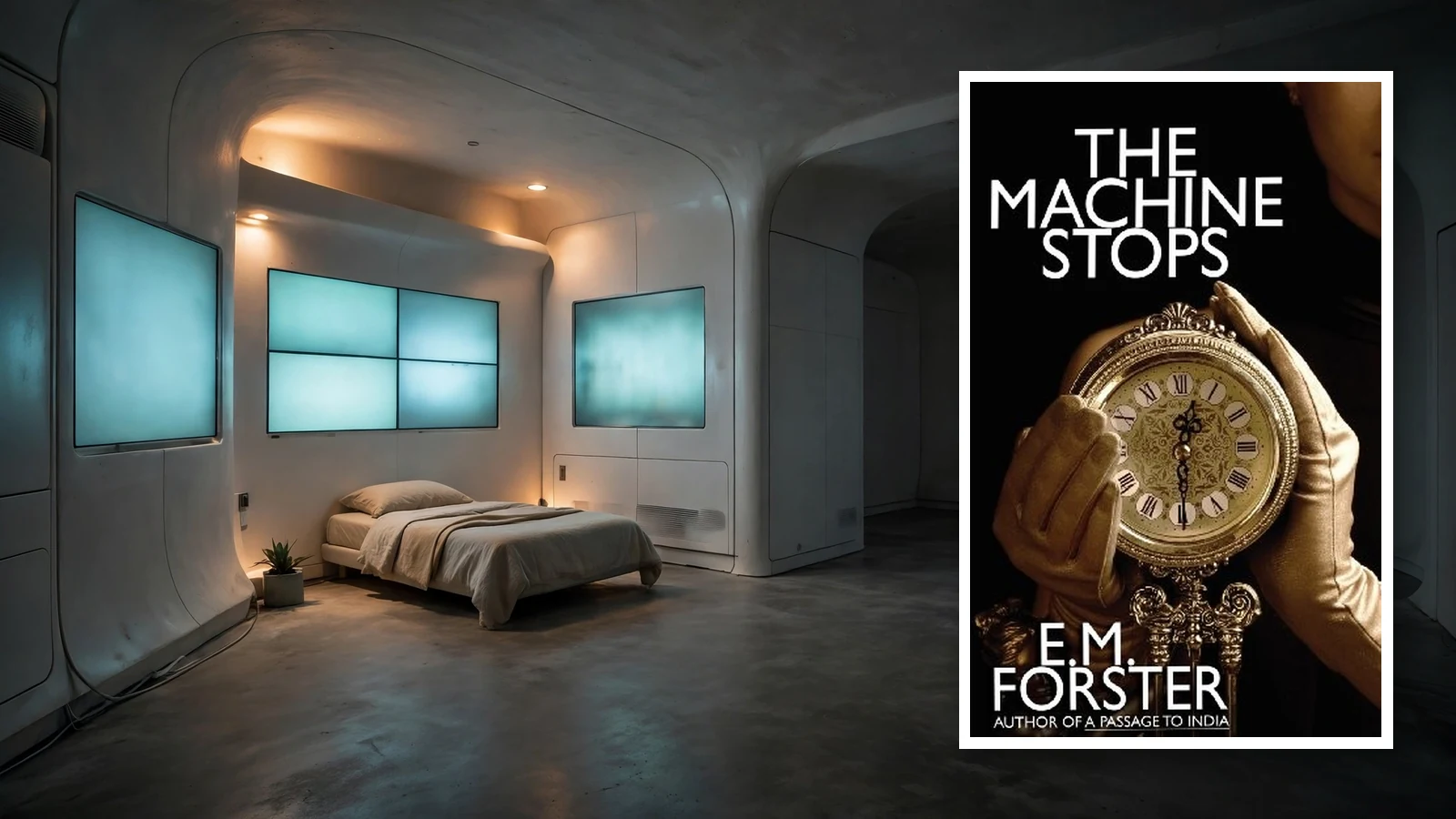
Vashti lives alone in a small underground room. The Machine brings her food, light, music, and company. She talks to her friends on glowing screens, and she has never met most of them in person. When her son Kuno asks her to visit him, she dreads the trip. The airship ride is uncomfortable. Face to face conversation feels awkward and slow. She would rather go back to her room and talk through the screen.
E. M. Forster wrote this story in 1909. There was no television, no internet, and no video calling. Yet he described video calls, instant messaging, remote lectures, and a world where people work, learn, and socialize without leaving their rooms. He even described a machine that answers questions, plays music on request, and knows what its owner wants before they ask.
At a glance
Genre: Science fiction short story, dystopia
Author: E. M. Forster
Year: 1909
Goodreads rating: 4.07/5
Kuno is the rebel of the story. He wants to see the surface of the Earth with his own eyes. He wants to touch real things and breathe real air. His mother thinks he is mad. The Machine has made life so easy that nobody remembers how to do anything for themselves, and the story shows what happens when the system starts to fail.
The ending is bleak, but the warning is clear. Forster was not afraid of machines. He was afraid of people handing over every part of life to them. A century later, we work from home, order dinner from a screen, and talk to friends we have never met. Read this one first. At about 12,300 words, it takes less than an hour, and it is the oldest book on this list by nearly sixty years.
There is one more detail worth noticing. Vashti’s friends send her ideas, not letters, and she rates the ideas she receives. Forster imagined a world where attention itself is the currency, and where a person’s worth is measured by how many people listen to them. Social media runs on exactly that trade, and it was described in full a century before the first like button.
2. Do Androids Dream of Electric Sheep?

It is 2021, and World War Terminus has left the Earth a dusty, half-empty place. Most animals are extinct, so people keep electric copies instead. Rick Deckard owns an electric sheep, and he is ashamed of it. Real animals cost a fortune, and owning one proves you are still human. His job is to hunt down androids that look so much like people that only an empathy test can tell them apart.
Philip K. Dick published the novel in 1968. There were no home computers, no smartphones, and no chatbots. Yet he imagined a mood organ that lets you dial up an emotion before breakfast, an empathy box that connects strangers through a shared screen, and machines built to pass as living things. The film Blade Runner, released in 1982, took the same story and made it famous.
At a glance
Genre: Science fiction, dystopian novel
Author: Philip K. Dick
Year: 1968
Goodreads rating: 4.09/5
Buy: No verified Amazon link found in search, search the title on Amazon
The prediction that landed hardest is the android. We do not have replicants yet, but we do have AI companions, chatbots that talk like friends, and robots that look you in the eye. The question Dick asked is now a daily one: if a machine can sound kind, remember your birthday, and say it cares, what exactly makes us different from it?
Deckard’s test for androids measures empathy, the one thing machines were supposed to lack. Today we argue about whether AI can feel, whether chatbots should be allowed to comfort lonely people, and where the line sits between a tool and a friend. Dick drew that line in 1968, and we are still redrawing it.
The electric animals are the detail readers remember most. In Deckard’s world, a real animal is a status symbol, and a fake one is a secret shame. We are not there yet, but the direction is familiar: robot pets already comfort hospital patients and lonely elders, and lab-grown meat already sits on shop shelves. Dick’s question was never about the sheep. It was about what we do when the fake version is good enough.
3. Neuromancer
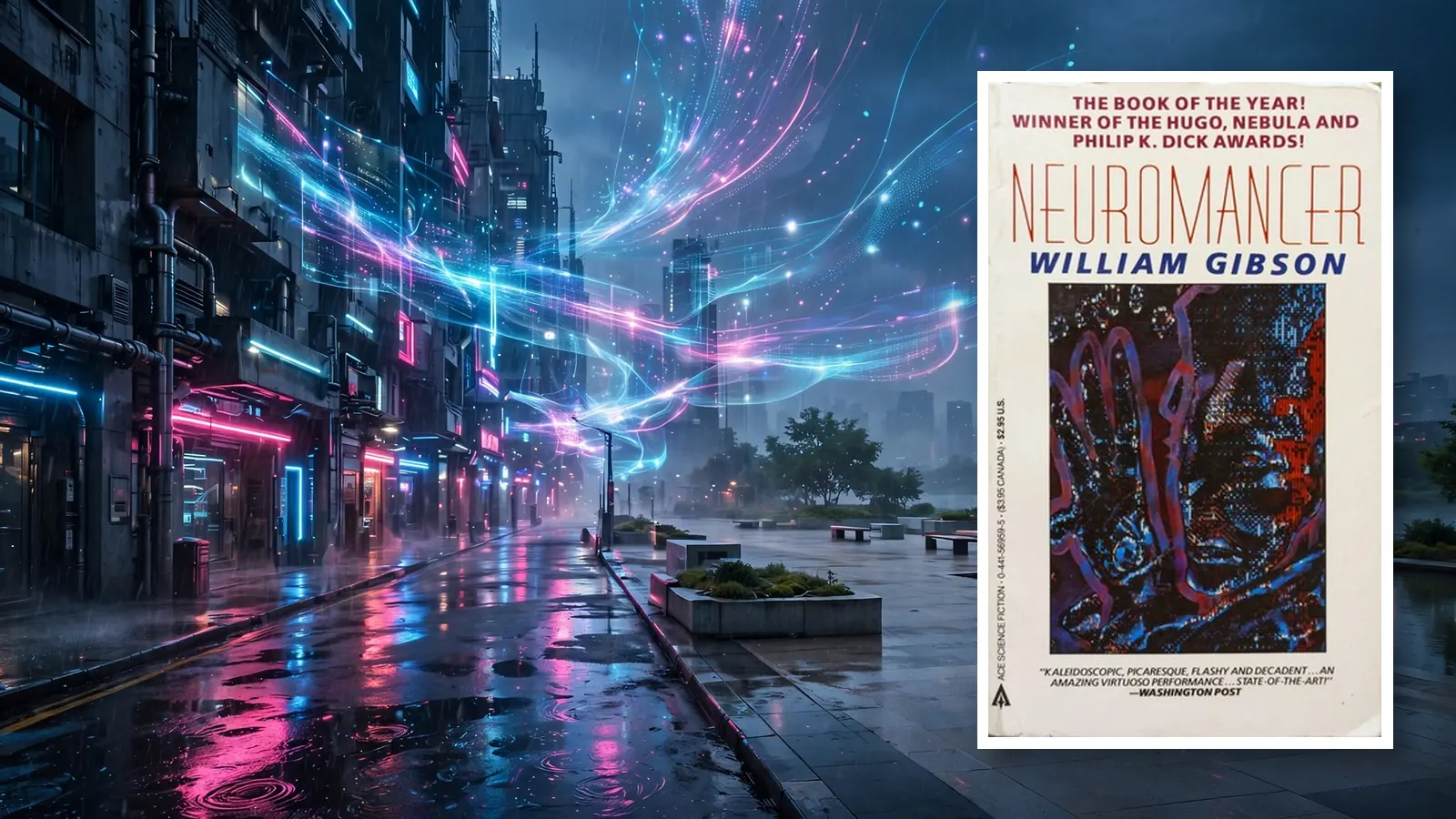
Case is a computer hacker who stole from the wrong people and paid for it with his nervous system. He cannot jack into cyberspace anymore, and in his world that is the same as being dead. Then a shadowy employer offers him a cure, a new bodyguard named Molly with mirrored eyes and blades under her nails, and one last run against an artificial intelligence called Wintermute.
William Gibson published the novel in 1984, the year the first Apple Macintosh went on sale. He invented the word cyberspace and described a shared virtual world that people enter through their computers, a global network of data, and hackers who steal information instead of money. It became the first novel to win the Hugo, Nebula, and Philip K. Dick awards, all three in the same year.
At a glance
Genre: Cyberpunk, science fiction
Author: William Gibson
Year: 1984
Goodreads rating: 3.88/5
The book got the internet right in spirit, if not in detail. We live inside Gibson’s matrix now: we work, shop, argue, and fall in love through screens. Companies in the book are more powerful than governments, and the richest prize is data, not gold. Read the news on any given day and you will find a headline that sounds like a chapter.
Gibson also got artificial intelligence right. Wintermute is not a robot with a face. It is a mind made of code, patient and vast, moving money and people like pieces on a board. The AI systems of today are simpler than Wintermute, but the questions are the same: who controls them, what do they want, and what happens when they start making their own plans?
The book is famously hard to read on the first try. Gibson throws the reader into the deep end, with slang, brand names, and technology explained only by context. Stick with it. The second half moves fast, the heist lands, and the final chapters explain why Wintermute wanted the run all along. It is the only book on this list where the future it predicted is also the genre it founded.
How the predictions landed
Each book saw one piece of the future clearly. Together they cover almost everything we do online today.
4. Snow Crash
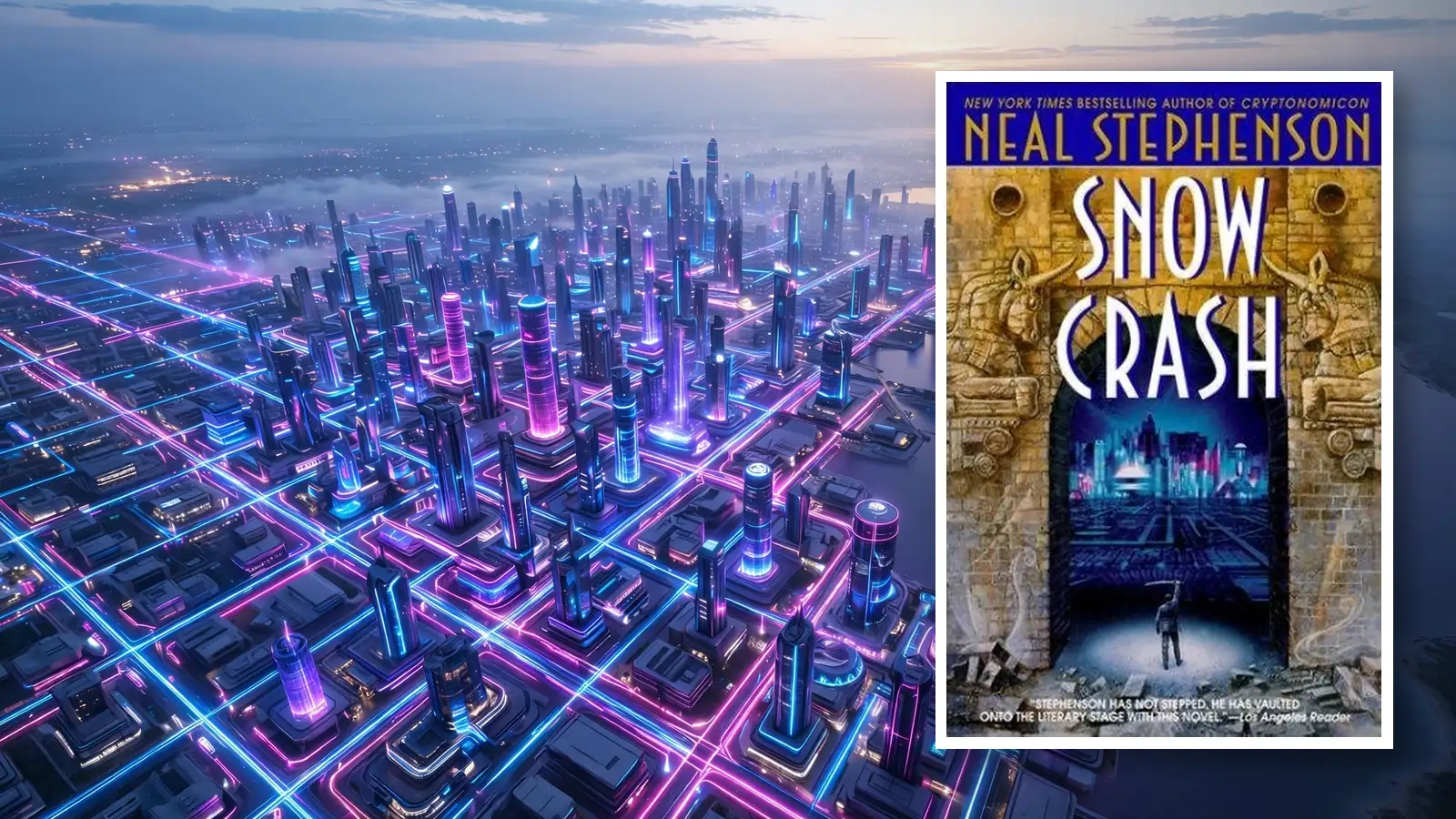
Hiro Protagonist is the greatest sword fighter in the Metaverse, a virtual world where everyone has an avatar and the streets are always crowded. In the real world he delivers pizza for the Mafia, and he is late. Then a new drug called Snow Crash starts crashing hackers’ brains, in the virtual world and in real life, and Hiro has to find out how a virus can infect a human mind.
Neal Stephenson published the novel in 1992, when the web was barely a year old and almost nobody had an email address. He described a shared 3D virtual world, digital avatars, and a society where private companies run everything, from the highways to the police. He even named his virtual world the Metaverse, the same word a social media giant later took for its own company.
At a glance
Genre: Cyberpunk, science fiction
Author: Neal Stephenson
Year: 1992
Goodreads rating: 4.01/5
Buy: Snow Crash on Amazon
The prediction that keeps landing is the gig economy. Hiro’s pizza job comes with a thirty-minute guarantee and a brutal penalty for being late. Today millions of people deliver food, drive strangers, and take freelance jobs through apps, rated by stars and paid by the task. Stephenson saw a world where work is fast, tracked, and disposable, and he wrote it as comedy.
The book is also the funniest on this list. It is loud, strange, and packed with ideas, from Sumerian myth to virtual real estate. Some readers find the middle too dense, and the ending too quick. But as a prediction, it is hard to beat: virtual worlds, avatars, online status, and a virus that spreads through a screen all arrived on schedule.
Stephenson also predicted the delivery app. Hiro’s employer tracks his speed to the second and punishes lateness without mercy. The joke is that the Mafia runs the pizza company, because only the Mafia takes delivery times that seriously. Thirty years later, every delivery driver works under the same clock, and the joke reads less like satire and more like a job description.
5. The Circle

Mae Holland has just landed her dream job at the Circle, a tech company that has swallowed search, social media, shopping, and email into one system. The campus is beautiful, the perks are endless, and her coworkers are thrilled for her. Then the company asks for a little more: wear a camera, share everything, rate everything, and let one login follow you everywhere. Privacy, her bosses say, is theft.
Dave Eggers published the novel in 2013, when smartphones and social media were already everywhere. That makes its predictions the most unsettling of the five, because it had the least distance to travel. The Circle’s TruYou system gives every person one online identity. Its SeeChange cameras let anyone watch anything, live. Its social scores rank employees by how much they share.
At a glance
Genre: Dystopian novel, techno-thriller
Author: Dave Eggers
Year: 2013
Goodreads rating: 3.50/5
Buy: The Circle on Amazon
Almost all of it has arrived. We log into apps with one account. We livestream our days. We wear cameras on our bodies and rate drivers, hosts, and dates with stars. Some countries score citizens on behavior, and employers check social media before they hire. Eggers did not invent these things. He saw where they were heading and wrote the destination down.
The Circle has the lowest Goodreads rating on this list, and part of the reason is the point: Mae keeps agreeing, and readers keep wanting her to stop. That frustration is the book working as intended. It is a warning written in the present tense, and every year since 2013 has made it a little harder to call it fiction.
Eggers wrote a sequel, The Every, in 2021, in which the Circle merges with a shopping giant and the surveillance grows even tighter. It is worth reading after this one, but it is not on this list, because its predictions are still being tested. The Circle earned its place here the old-fashioned way: by watching its guesses come true, one at a time, over twelve years.
Your reading order
Five books, five evenings. The shortest first, the scariest last.
That is the list: five books, five futures, and one uncomfortable pattern. The writers were not fortune tellers. They were careful watchers. They looked at the machines of their own time, imagined what would happen if those machines got smaller, faster, and closer, and wrote down the answer.
The hopeful part is that the books are warnings, not verdicts. Forster’s characters forgot how to live without the Machine, but we still have a choice about how much of life we hand over. Dick’s androids asked what makes us human, and the answer is still ours to give. Gibson and Stephenson built wild futures, and then real engineers built pieces of them for fun.
Start with the shortest one tonight. The Machine Stops takes less than an hour, and it will change how you look at your phone for a week. Then work forward through the decades, and watch the future arrive one prediction at a time. The last book on the list was published in 2013. The next great prediction is probably being written right now.

John Smith is the founder and CEO of Karaoke Machines Guru. He is a karaoke tutor and karaoke enthusiast and has been passionate about karaoke since he was a child. He also writes about karaoke-related tips, guides, and product reviews on this website.
He overlooks the whole website and makes sure that everything is running smoothly. Learn more!