
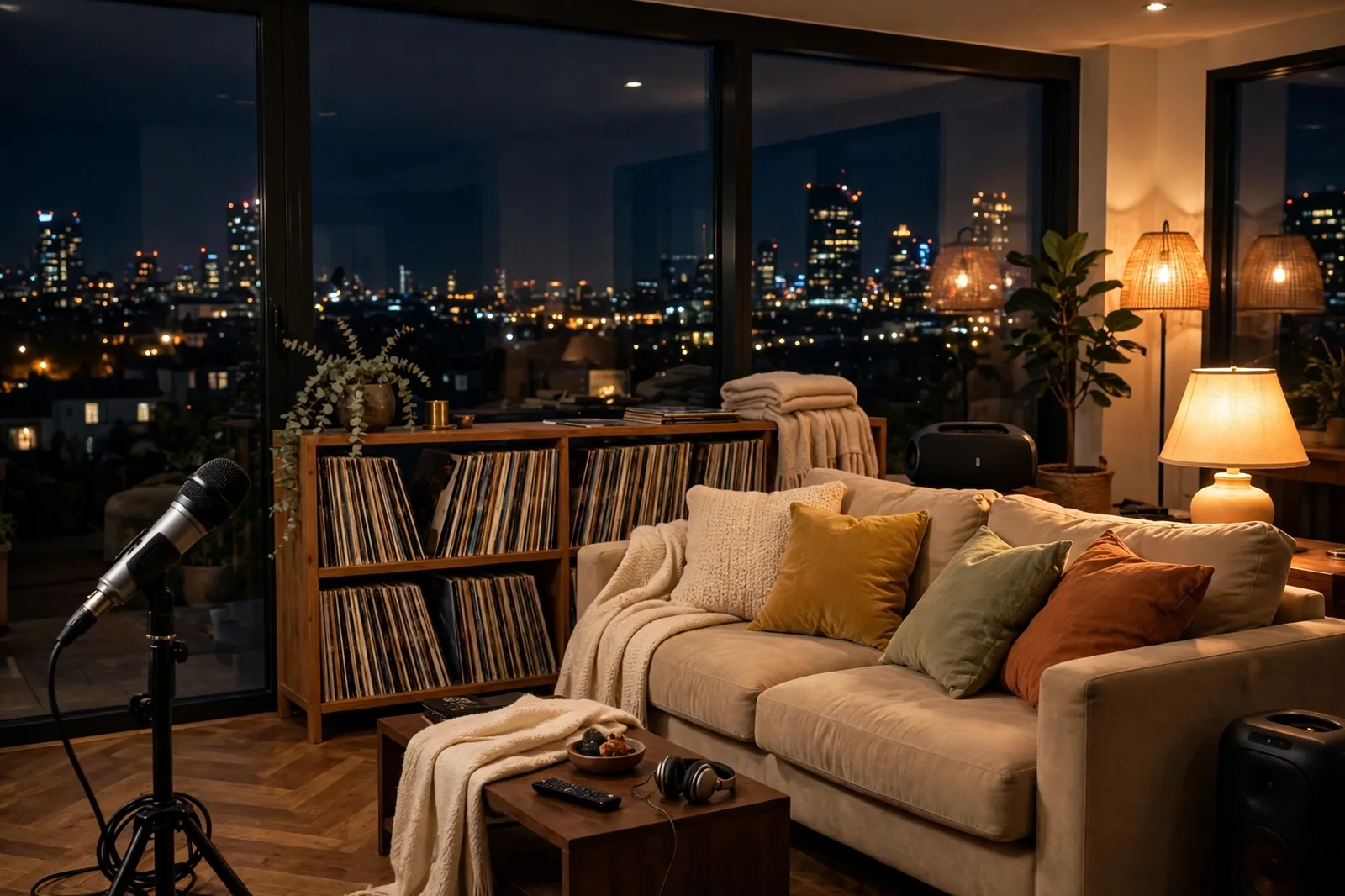
The 2027 Grammy nominations were announced on November 16, 2026, and RAYE leads the field with 11 nominations. New songs will get their night in the spotlight soon enough. But some nights are not about what is new. Some nights are about the song you already know by heart, the one you sing when the house is quiet and sleep will not come.
Everybody knows that hour. It is 2 AM, the lights are low, and your brain will not switch off. You could count sheep. You could scroll your phone until your eyes hurt. Or you could pick up the mic, or just sing to the ceiling, and let a great song do what sleep cannot.
The songs below were picked for that exact hour. They are slow enough to sing half awake and strong enough to carry real feeling. Each one works in a living room with one lamp on, and each one sounds even better when you sing it like you mean it.
A quick note on the list. These are songs for singing, not just listening. We judged each one on how it feels to sing at 2 AM, how forgiving it is when your voice is tired, and how good the room feels after the last note. Work through them in order, or jump straight to the one calling your name.
1. The Night We Met
Some songs sound like a memory. This one sounds like the moment you wish you could walk back into. Lord Huron released it on Strange Trails in 2015, and it stayed a quiet favorite for years before a television show carried it to millions of new ears. The single followed in 2017, but the album is where the song was born.
The whole song moves at a walking pace, which is exactly why it works at 2 AM. The vocal sits low and unhurried, and the melody leaves room to breathe between lines. You do not need a big voice for this one. You need a steady one, and the patience to let each line land.
Year: 2015
Best for: the first song of a quiet night
Karaoke tip: keep it soft and let the room lean in instead of pushing the chorus
The trick is restraint. Sing it like you are telling someone a secret, not like you are performing for a crowd. If the room goes quiet, that means it is working.
Save this one for the first song of the night. It sets the mood for everything after it, and it tells the room that tonight is for feeling things, not shouting over them.
2. Vienna
Billy Joel wrote Vienna for his 1977 album The Stranger, and it was never even a single. It came out as the B-side to Just the Way You Are, and it spent decades as a deep cut before streaming turned it into one of his most loved songs. Joel has said it is one of his own favorites, and crowds at his shows pick it over the hits.
The lyric is a gentle warning against rushing your life, and that is why it fits a sleepless night so well. At 2 AM every worry feels urgent. Vienna answers back: slow down, you crazy child. The piano carries the song, so a singer can lean on the melody and let the words do the heavy lifting.
Year: 1977
Best for: slowing a restless night down
Karaoke tip: play it at piano pace, not metronome pace; the pauses are part of the song
Keep the tempo relaxed and do not push the high notes. The song is a conversation, not a contest. When the last line lands, the room usually sits still for a second. Let it.
It also works as a reset button. If the night has felt rushed and loud, Vienna slows everything down to a human pace again, and that is a gift at any hour.
3. Dreams

Stevie Nicks wrote Dreams in about ten minutes, sitting at a piano in a studio room with a drum pattern running. It became the second single from Rumours in March 1977, and the band’s only number one single in the United States. The story behind it is messy, two band members breaking up while recording an album together, but the song itself sounds calm as still water.
That calm is the secret. The groove never hurries, the vocal floats over three simple chords, and the chorus is one of the easiest great choruses ever written. At 2 AM, when your voice is tired, this is the song that meets you where you are.
Year: 1977
Best for: the moment everyone is still awake
Karaoke tip: ride the groove and let the chorus lift you; do not rush the verses
Let the chorus lift you. Do not force it. The line about thunder only happens when it is raining works best sung softly, like you are thinking out loud. Everyone in the room will know the words. Let them sing along.
Dreams is also proof that a sad song does not have to sound sad. It moves, it grooves, and it still feels like 2 AM. That combination is rarer than it looks.
4. Hallelujah
Leonard Cohen wrote Hallelujah and released it on his 1984 album Various Positions, but the version most singers reach for is Jeff Buckley’s. Buckley recorded it for his only studio album, Grace, released in August 1994, after hearing John Cale’s 1991 cover. His take is slower, sadder, and built for a quiet room.
This is the hardest song on this list to sing well, and the most rewarding. The melody climbs and falls in long lines, and every word has to land cleanly or the spell breaks. At 2 AM, with the lights low, it can silence a whole room. It can also expose every crack in a tired voice, so go in with your eyes open.
Year: 1994
Best for: a room gone silent
Karaoke tip: sing it slowly and save your breath for the long lines; the high notes need air, not force
Breathe deep and take your time. The famous lines about the baffled king work best when you sing them like a story, not a showpiece. If your voice shakes a little, let it. This song has room for that.
One warning: do not follow it with anything loud. Hallelujah needs silence after it, the way a good meal needs a pause before dessert. Give the room a minute.
5. Fix You
Chris Martin wrote Fix You for Coldplay’s third album, X&Y, and the band released it as a single on September 5, 2005. It reached number 4 in the United Kingdom. The song grew out of grief: Martin wrote it to comfort his wife after her father died. That is why it never sounds like a performance. It sounds like someone sitting next to you in the dark.
The build is the whole trick. It starts with a soft organ and a near whisper, then guitars and drums arrive one by one until the whole song opens up. At 2 AM that slow climb feels like the night itself turning a corner. You start small and end up somewhere bigger.
Year: 2005
Best for: the big finish of a late session
Karaoke tip: start almost whispering and build with the song; the payoff is in the climb
Do not rush the quiet opening. The crowd, or the empty room, needs those first lines to be almost spoken. Then let the band, or your own voice, carry the ending. This is the song that makes a late night feel like it meant something.
If you only sing one song from this list tonight, make it this one. It is the closest thing here to a hug set to music.
6. Let It Be
Paul McCartney wrote Let It Be, and The Beatles released it as a single on March 6, 1970, two months before the album of the same name. It was the last single the band released while they were still together. The words came from something his mother once said to him in a dream, and the song has comforted people ever since.
The piano part is simple enough that almost anyone can find it, and the melody is one of the most singable ever written. That is why it works at 2 AM: you do not have to think about the notes. You just have to mean the words. When you cannot fix what is keeping you awake, sometimes the only honest thing to sing is to let it be.
Year: 1970
Best for: a whole-room singalong
Karaoke tip: invite the room in on the chorus; this one sounds better shared
Invite the room in on the chorus. This song was built for more than one voice. Even a tired voice sounds good on the line about whispering words of wisdom, because the wisdom is the point, not the singing.
It is also the most forgiving song on this list. Miss a note and nobody minds. The melody is so strong that it carries you home by itself.
7. Mad World
Tears for Fears released Mad World in September 1982, and it became their first big hit. But the version for a sleepless night belongs to Gary Jules. He recorded it with composer Michael Andrews for the film Donnie Darko in 2001, stripping away the synths and drums until only piano and voice were left. That version reached number one in the United Kingdom as a single in December 2003.
The Jules version is all space. The piano plays a few simple chords, the vocal stays low, and the silence between lines does as much work as the notes. It is the sound of a mind going around in circles at 3 AM, and singing it feels like finally saying that out loud.
Year: 2001
Best for: the moody middle of the night
Karaoke tip: use the Gary Jules version, piano and voice only; keep the tempo slow
Sing it slowly and do not decorate it. The song needs stillness more than it needs range. If you rush, the mood breaks. If you let it breathe, the room will hold its breath with you.
This is the one to pick when the night feels strange and you want a song that admits it. You will feel less alone by the last line, and that is the whole point.
8. Everybody Hurts

Everybody Hurts appeared on R.E.M.’s eighth album, Automatic for the People, in 1992, and the band released it as a single in April 1993. Much of it was written by drummer Bill Berry, which surprises people, because it became one of the band’s most loved songs. The band wrote it as a message for teenagers going through dark times, plain and direct on purpose.
The lyric could not be simpler, and that is the point. When you are awake at 2 AM with your thoughts going in circles, a complicated song is the last thing you need. This one says the thing straight: everybody hurts sometimes, so hold on. The strings, arranged by John Paul Jones of Led Zeppelin, lift the ending without ever rushing it.
Year: 1992
Best for: when the room needs comfort
Karaoke tip: keep the verses plain and steady; let the ending swell on its own
Keep the verses plain. The song is a message, not a showcase, and it works best when you sound like you believe every word. Save your strength for the final hold on, and let it ring.
If someone in the room is having a hard night, this is the song to sing for them. It does not try to fix anything. It just says you are not alone, and sometimes that is enough.
9. The Sound of Silence
Paul Simon wrote The Sound of Silence in early 1964, and the duo recorded a quiet acoustic version for their debut album, Wednesday Morning, 3 A.M., released that October. The album flopped. Then radio stations started playing the song, producer Tom Wilson added electric guitars and drums without telling the duo, and the new single reached number one on January 1, 1966.
It is the perfect closing song for a sleepless night because it is about silence itself. The opening line, hello darkness, my old friend, is one of the most famous in popular music, and it feels written for 2 AM. Sing the acoustic version if you can. Two voices and a guitar are all it needs.
Year: 1964
Best for: closing the night
Karaoke tip: start quiet and let the harmonies build; the last verse earns the volume
Start almost in a whisper. Let the harmonies build slowly, and give the last verse everything you have left. When the final note fades, do not rush to fill the quiet. That quiet is the point of the whole list.
Sixty years on, the song still works exactly as it did on the night it was written. Some songs age. This one just waits for the next person who cannot sleep.
That is the list, nine songs for the hours when sleep will not come. Pick one, dim the lights, and sing it for yourself first. The room, the night, and your own tired brain will thank you.
If you try these at a real karaoke night, start with the gentle ones and save Fix You and Everybody Hurts for the end. A late set rewards patience. The best 2 AM songs are never the loudest ones in the room.
And if sleep still will not come after all nine, there is always one more verse. Some nights are just for singing. The morning will wait.

John Smith is the founder and CEO of Karaoke Machines Guru. He is a karaoke tutor and karaoke enthusiast and has been passionate about karaoke since he was a child. He also writes about karaoke-related tips, guides, and product reviews on this website.
He overlooks the whole website and makes sure that everything is running smoothly. Learn more!