
Black Friday landed on Friday, November 27 this year, and the sales stretch through Cyber Monday on Monday, November 30. This Saturday, November 28, sits right in the middle of the weekend, which makes it a good moment to buy a karaoke microphone with a clear head instead of a rushed one. A mic is the part of a home karaoke setup that decides how your voice sounds, and it is also the part most people buy last, after the speaker and the screen.
This guide keeps the focus on the microphone itself. Six picks cover the main ways people sing at home: one wired classic, two wireless pairs, one effects bundle, one four-mic system for big groups, and one pocket-size mic with its own speaker. Each one suits a different room, a different setup, and a different kind of singer.
Before you pick, check what you already own. A wired mic needs an input to plug into. A wireless pair needs a speaker or receiver it can talk to. A mic with a built-in speaker needs nothing else at all. Match the mic to the gear in your living room first, and the rest of the choice gets easy.
Wired or wireless? A quick way to choose
| Wired | Best sound for the money, no batteries, but you stay near the cable. Example here: Shure SM58. |
| Wireless pair | Freedom to move and easy duets, but you charge batteries or fit AA cells. Examples here: JBL and FIFINE. |
| All-in-one | Mic and speaker in one hand, nothing else to buy, but the sound stays small. Example here: BONAOK Q37. |
| Bundle or system | Most complete setup, with effects or four mics, but the most gear to store. Examples here: Singtrix and Phenyx Pro. |
1. Shure SM58-LC
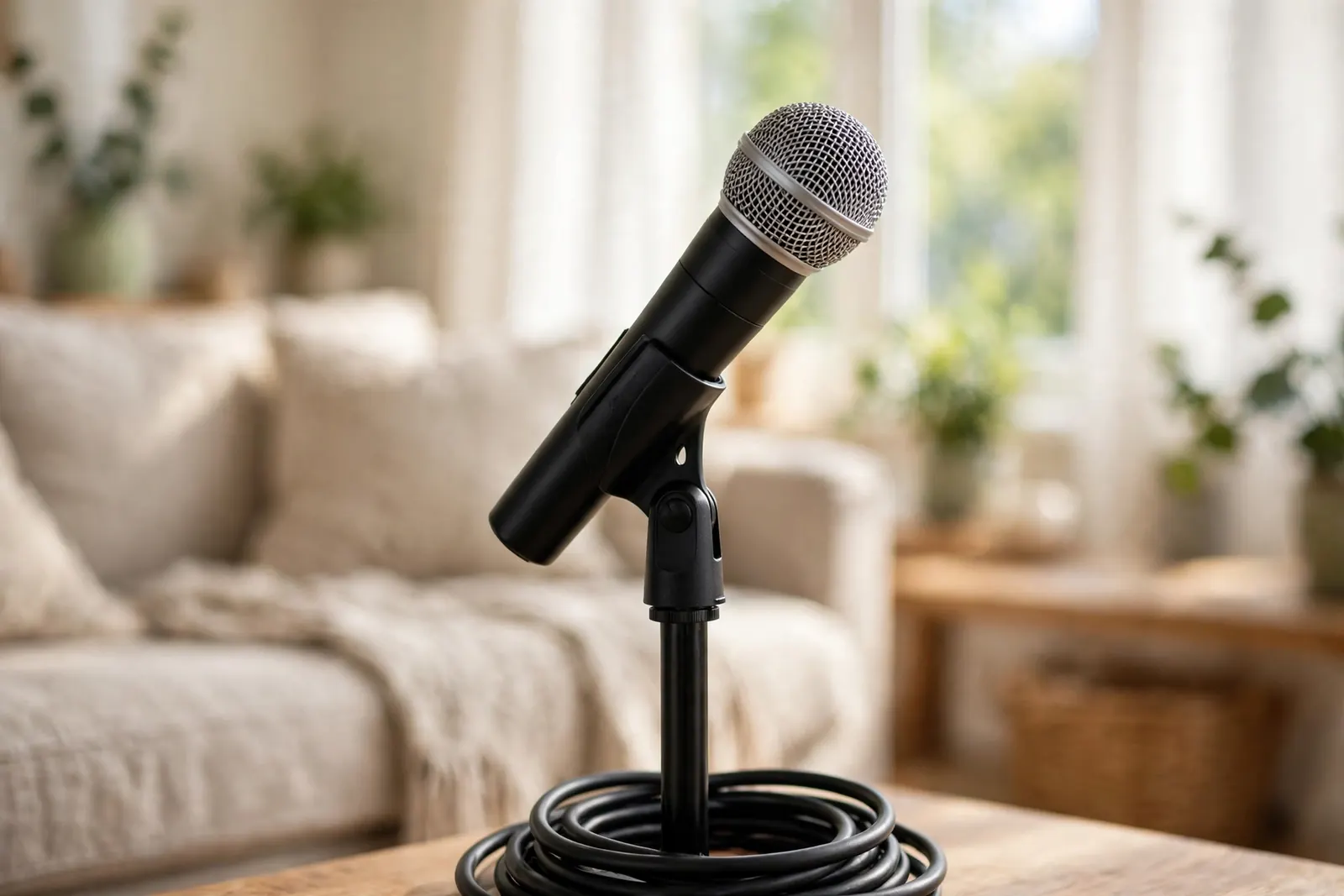
The SM58 is the mic you have already heard a thousand times, even if you never noticed it. It has been the standard vocal mic on stages for decades, and the same design works just as well in a living room. It is a cardioid dynamic mic, which means it picks up the voice in front of it and rejects much of the sound from the sides and behind. In plain terms, it hears you and ignores the room.
The build is the reason people keep buying it. A steel mesh grille, a built-in pop filter that softens hard consonants, and a pneumatic shock mount inside that cuts handling noise when you move the mic around. Its frequency response runs from 50 Hz to 15 kHz, tuned to keep voices clear and present. It connects by XLR, the three-pin plug used by mixers, powered speakers, and karaoke machines with a mic input.
At a glance
Best for: singers who want the clearest voice in this guide and do not mind a cable.
Key thing to check: the LC version ships without a cable, so confirm you own an XLR cable or add one, and confirm your speaker or mixer has an XLR mic input.
Shop: Shure SM58-LC on Amazon
One thing to know before you order: the LC version ships without a cable. The box holds the mic, a swivel stand adapter, and a storage bag. If you do not already own an XLR cable, you will need one, or look at the SM58-CN version, which adds a 25-foot XLR cable. You also need something to plug it into, since a wired mic makes no sound on its own.
A cardioid mic rewards good habits. Hold it a few inches from your mouth and point it at your lips, not at the speaker, and feedback stays away. Singers who cup the grille or point the mic at the floor will hear the difference right away. A cheap foam windscreen helps outdoors, and the metal body shrugs off the drops that kill plastic mics.
Who should buy it? Anyone who wants the best-sounding voice in this guide and plans to sing often. It is also the pick that will still be working years from now, which matters if karaoke night is a weekly habit in your house.
2. JBL PartyBox Wireless Mic
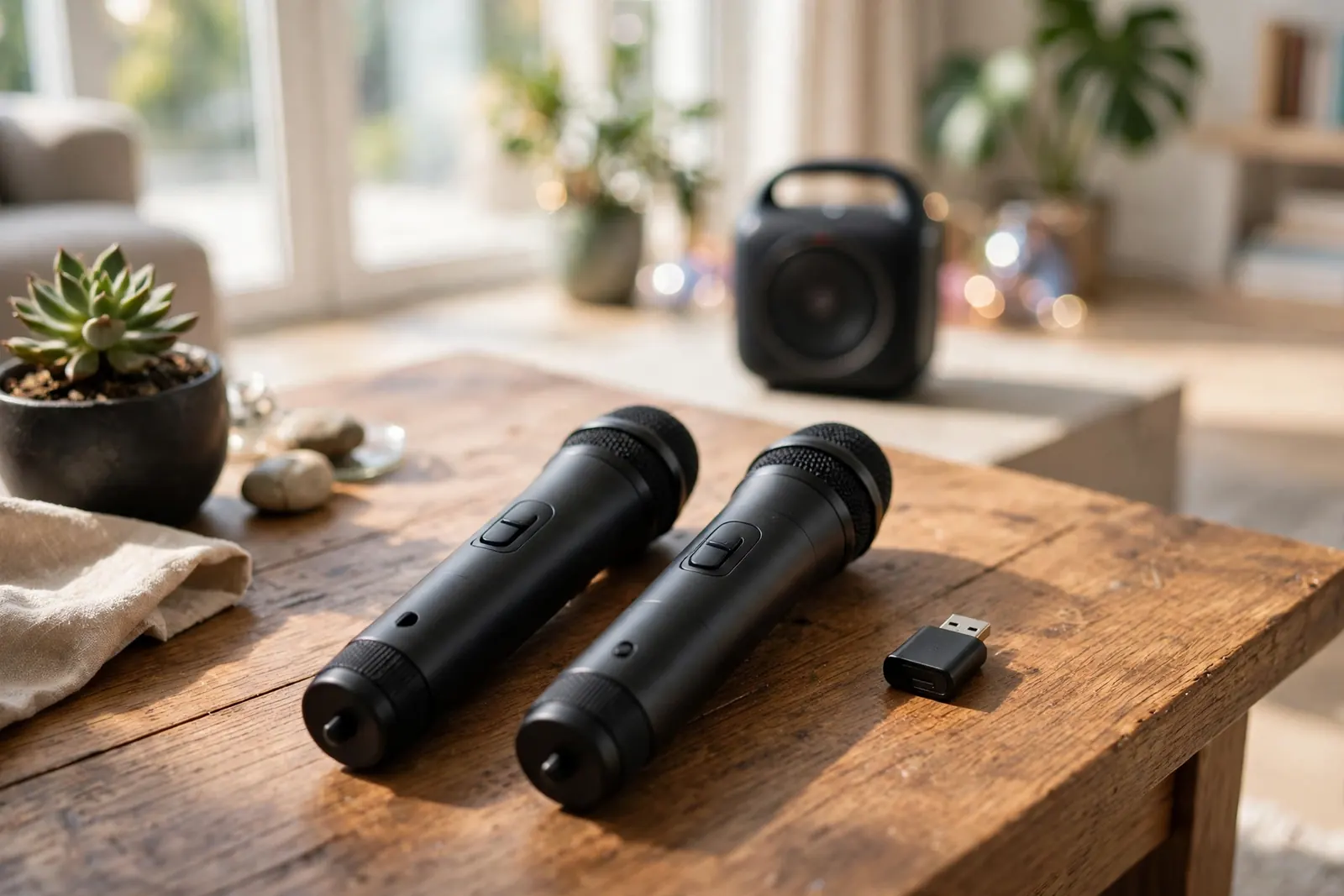
If you already own a JBL PartyBox speaker, this is the easiest pair of mics you can buy. The box holds two rechargeable handheld mics and a small USB dongle. Plug the dongle into the speaker and the mics connect over a stable 2.4 GHz link, with no receiver box and no cables to run across the floor.
Battery life is generous. JBL lists up to 20 hours of playtime, or up to 12 hours when the mics run through the dongle, and you can keep singing while a mic charges from the PartyBox built-in power bank. The mics are cardioid, so they focus on the singer and cut down room noise, and the range reaches about 30 meters from the speaker.
At a glance
Best for: PartyBox owners who want duets with no extra boxes or cables.
Key thing to check: these mics need a PartyBox speaker to make any sound, so confirm your speaker model is in the PartyBox line before you buy.
The catch is the one to check first. These mics are made for PartyBox speakers, and they need one to make any sound. If you own a PartyBox Encore, a 310, a 1000, or any other model in the line, they pair right up. If you do not own one, this is the wrong pick, no matter how good the mics look.
Setup takes about a minute. Plug in the dongle, switch on a mic, and the link locks by itself, with no app and no pairing menu to fight. The mics also work while they charge from the speaker, so a low battery in the middle of a set is a pause, not a dead end. Two mics also suit hosts and toasts, not just duets.
For duets, this pair is hard to beat. Two mics in the box means no passing one mic back and forth, and the rechargeable batteries mean no hunting for AA cells before the first song.
3. Singtrix Party Bundle
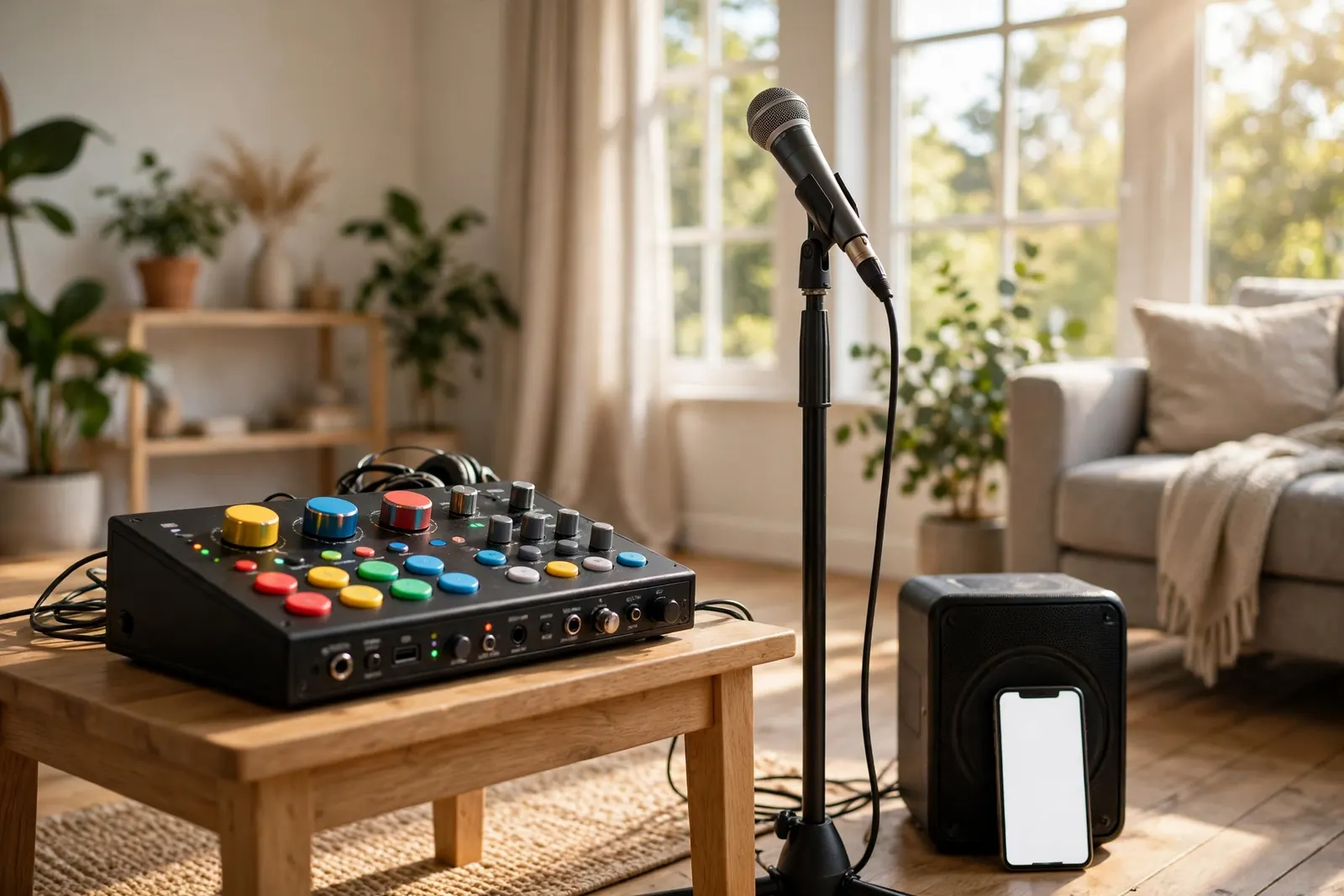
Singtrix is the pick for singers who want to sound better, not just louder. The bundle centers on a Studio Console that tunes your voice in real time, with more than 300 effect presets listed on its Amazon page, including natural pitch correction, harmonies, and reverb. A Hit Effect button adds backup harmonies on demand, so a chorus can suddenly sound like a group.
The box is a full setup: the console, one wired microphone, a full-size mic stand, a device holder for your phone or tablet, and a 40-watt 2.1 stereo speaker with a built-in subwoofer. You plug your phone into the 3.5mm input, pull up free karaoke tracks on YouTube, and sing. There is no Bluetooth and no USB audio connection, so the music arrives by cable.
At a glance
Best for: regular singers who want studio-style effects and pitch help built into the setup.
Key thing to check: the music connects by cable, not Bluetooth, and the bundle is the largest in this guide, so measure your storage space first.
The tradeoff is size and setup time. This is the largest bundle in this guide, with a console, a stand, and a speaker to find room for, and the mic is wired, so you stay near the stand. What you get in return is the most studio-like sound of the six, which is the whole point of the box.
The console has three skill levels, so a nervous first-timer can lean on heavier pitch help while a confident singer dials it back to a light touch. The voice cancellation feature lowers the lead vocal on ordinary songs, which opens up any track in your library, not just karaoke versions. That makes the bundle useful beyond party nights, for practice and for songwriting.
Buy it if you sing often and you want the effects to do some of the work. Skip it if you want something you can toss in a closet between parties.
Five checks before you buy any karaoke mic
- What input does your speaker have? XLR, 1/4-inch, 3.5mm, or a USB dongle slot. The mic must match it.
- Does the box include the cable? Some mics ship without one, and a missing cable delays the first song.
- Batteries or rechargeable? AA mics need spares on hand. Rechargeable mics need charging time before the party.
- How many singers at once? One mic suits solos. Duets need a pair, and big groups need a four-mic system.
- Where will it live between parties? A full bundle needs shelf space. A pocket mic fits in a drawer.
4. Phenyx Pro PTU-5000-4H
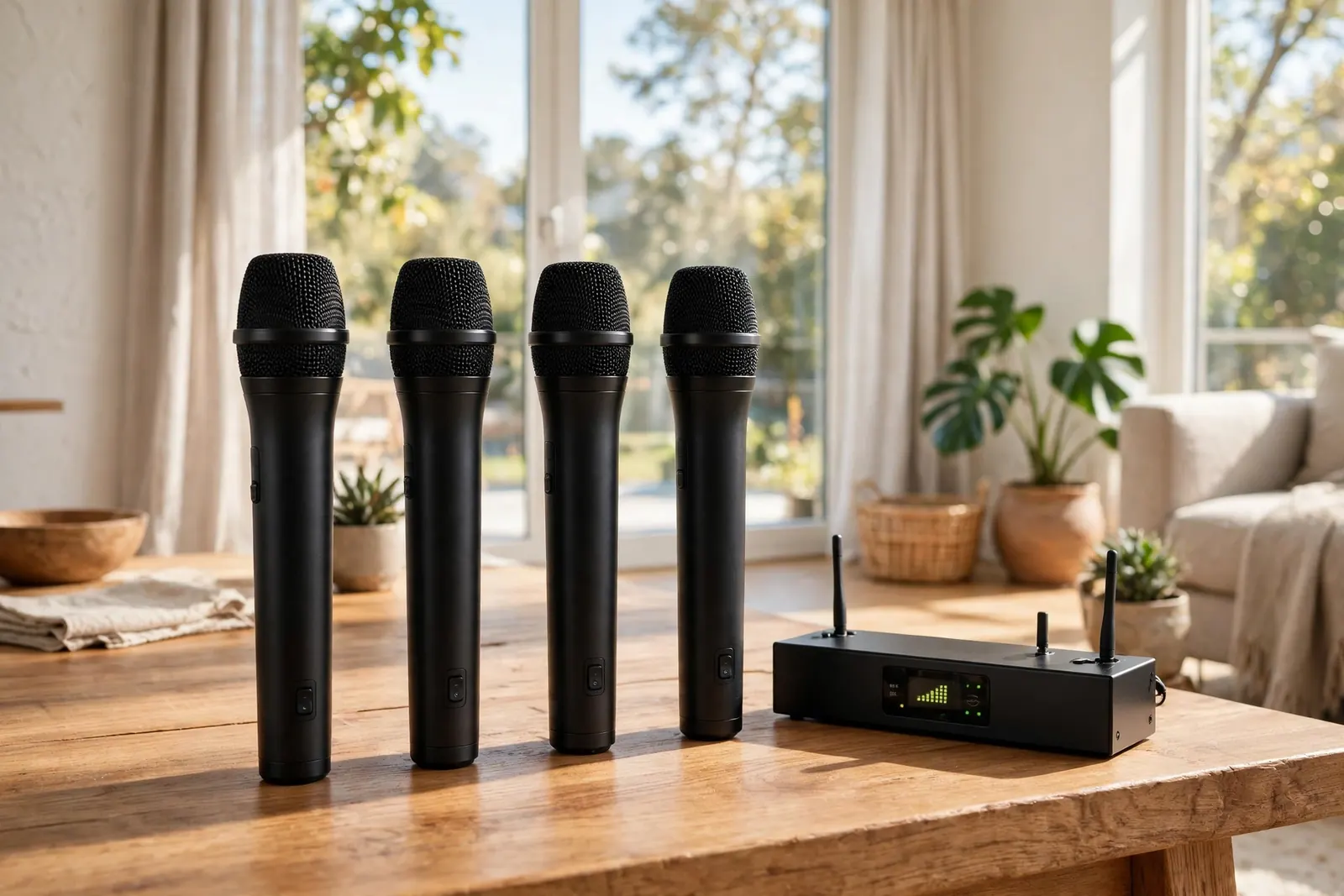
Four singers, four mics, one receiver. The Phenyx Pro PTU-5000-4H is built for the nights when two mics are not enough: big family gatherings, church halls, and parties where everyone wants a turn. Each of the four handheld mics runs on its own fixed UHF frequency, 541.9, 546.3, 561.6, and 568.65 MHz, which keeps the signal stable and free of the dropouts that plague cheaper sets.
The receiver is all metal, with a separate volume knob for each channel, four XLR outputs, and a 1/4-inch output, so you can route each voice to a mixer or speaker on its own. The stated range reaches up to 260 feet in open space, and the box includes eight AA batteries, enough for up to 8 hours of use.
At a glance
Best for: big groups, family gatherings, and small halls where four people sing at once.
Key thing to check: this is a mic system, not a sound system, so you need an amplifier, powered speaker, or mixer. Also confirm the listing says PTU-5000-4H, the four-handheld version.
This is a mic system, not a sound system. It needs an amplifier, a powered speaker, or a mixer to make any noise, and the fixed frequencies mean you cannot retune a channel if you hit interference. The 4H in the model name matters: this version ships with four handheld mics, while the base PTU-5000 ships with two handhelds plus bodypacks, so check the listing before you buy.
Setup is quick for a four-channel system. The receiver remembers your settings with a memory switch, so the next session starts where the last one ended. Two snap-on antennas fit onto the back, and the LCD display shows each channel frequency at a glance. Rack mounting is possible too, if the system lives in a permanent setup.
If your living room turns into a stage for a dozen people at the holidays, this is the set that keeps everyone singing at once.
5. FIFINE K036
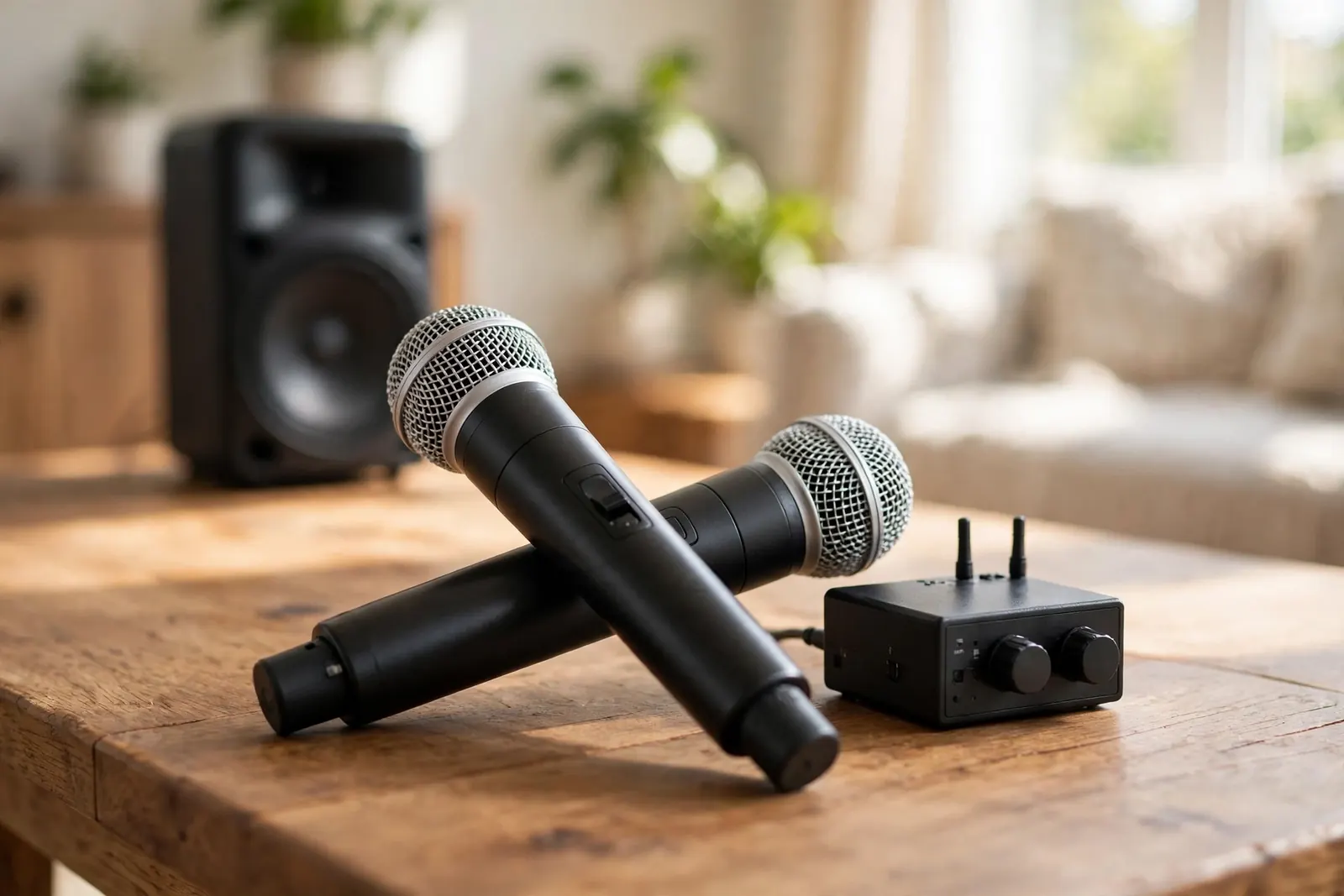
The FIFINE K036 is the simplest wireless pair in this guide, and for many living rooms it is all you need. Two UHF handheld mics, a compact metal receiver, separate volume knobs for each mic, and an echo knob on the receiver that adds a little karaoke shine without any extra gear. It runs on the UHF band from 520 to 578 MHz, with a stated range of up to 80 feet.
The box does a lot of the thinking for you. Three audio cables come included, a 1/4-inch cable, a 3.5mm cable, and a 3.5mm-to-RCA cable, so the receiver connects to a powered speaker, an amp, or an older stereo without a separate trip to the store. There is also a 1/4-inch input for a third wired mic if a trio wants to sing.
At a glance
Best for: first-time wireless buyers who want duets and already own a speaker.
Key thing to check: each mic takes two AA batteries, four in total, and they are not rechargeable. There is no Bluetooth, so confirm your speaker takes an analog input.
Shop: FIFINE K036 on Amazon
The limits are honest ones. Each mic takes two AA batteries, so four in total, and they are not rechargeable. There is no Bluetooth, and some smart TVs need a digital-to-analog converter to take the receiver analog output. The 80-foot range is shorter than the bigger systems here, but in a living room that rarely matters.
It also suits more than karaoke. The same pair works for speeches, school events, and church announcements, anywhere two voices need to reach a room. If your TV is the music source, check its audio outputs first, since some smart TVs need a small converter box to feed an analog receiver. That one check avoids the most common setup headache with this system.
Pick this one if you want wireless duets on a modest budget and you already own a speaker to plug the receiver into.
6. BONAOK Q37
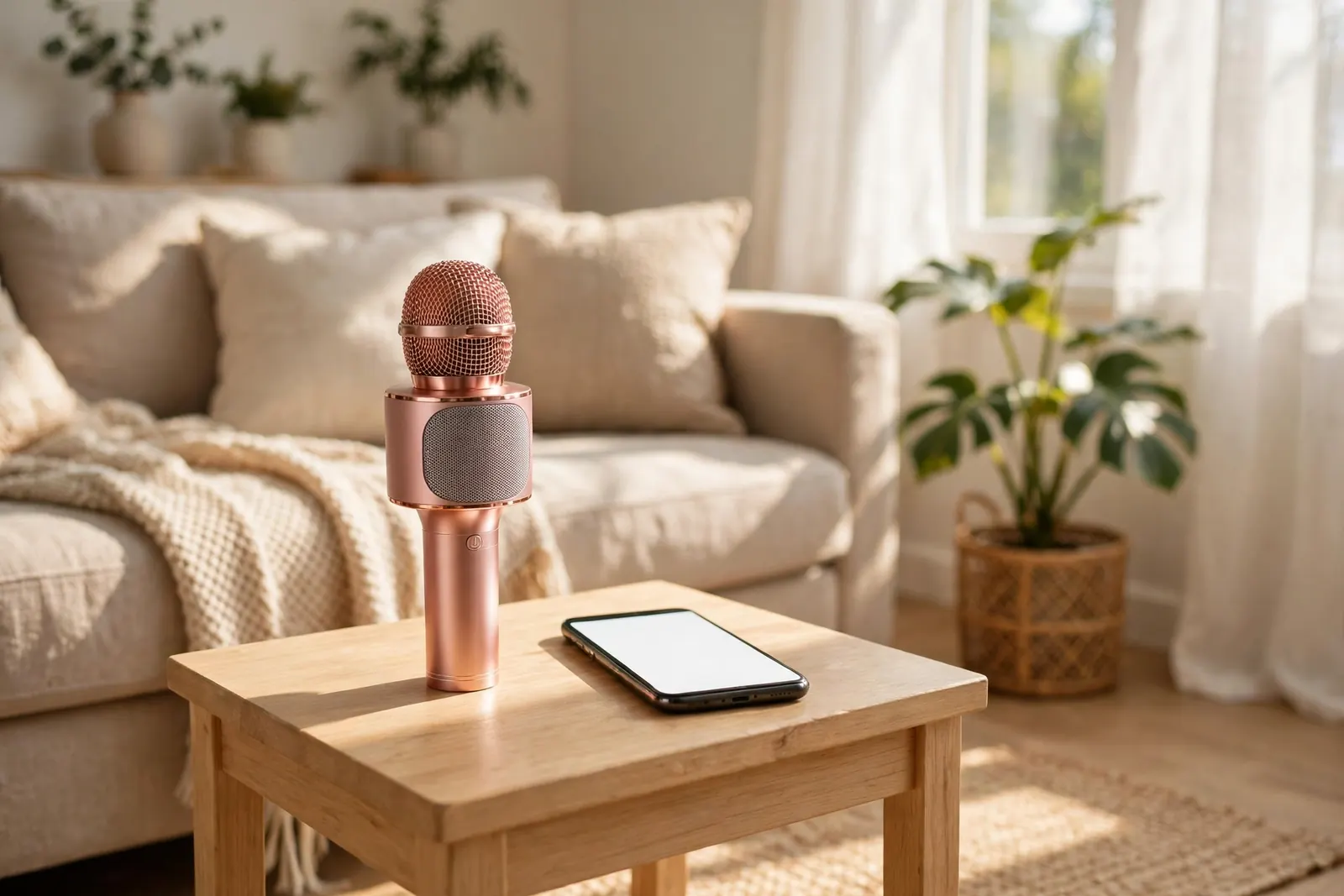
The BONAOK Q37 is the smallest setup in this guide, and also the simplest. It is a single handheld mic with a speaker built into its body, plus Bluetooth, so you pair it to your phone, play a song from any app, and sing. No speaker, no receiver, no cables, and nothing else to buy. It weighs 365 grams and its aluminum body comes in several colors, including rose gold.
The built-in speaker puts out 6 watts, which fills a living room or a bedroom just fine, though it will not carry a big hall. The listing gives a sing time of up to 5 to 10 hours on a charge, with about 2 hours to recharge, and a Bluetooth range of about 10 meters. Echo and voice controls sit on the mic itself, and a wired mode with the included audio cable lets you record while you sing.
At a glance
Best for: kids, casual singers, and anyone who wants karaoke running in under a minute.
Key thing to check: the 6-watt built-in speaker suits a room, not a hall, so do not expect it to fill a big space.
Shop: BONAOK Q37 on Amazon
Keep your expectations in line with the size. This is a fun mic, not a pro one, and the voice will not sound as full as it does through a larger speaker. What it does better than anything else here is start a karaoke night in under a minute, which is exactly what kids and casual singers need.
The mic also works as a standalone Bluetooth speaker and can play songs from a TF card, so it doubles as a travel speaker for picnics and road trips. The wired mode lets you record while you sing, which kids love for making their own little performances. At 365 grams it is light enough for small hands to hold through a whole song.
It also makes a strong gift. One mic, one charge cable, and a phone are the whole setup, so it suits birthdays, stockings, and anyone who wants to sing without assembling a system first.
First-night setup in five steps
- Charge or fit batteries before the guests arrive, and keep spares nearby.
- Connect the receiver or dongle to your speaker, then switch the mics on and test each one.
- Plug in your music source, usually a phone or tablet, and pick the first song.
- Test the mic volume with a quick spoken count before anyone sings, so the first song is not a scramble.
- Keep a spare cable and batteries within reach, so a dead mic never ends the night.
The right mic depends on the room you sing in and the gear you already own. A wired classic rewards a singer who has a mixer or a powered speaker. A wireless pair frees up the floor. An effects bundle makes an average voice sound polished. A four-mic system ends the wait for a turn. And a pocket mic with its own speaker gets a party started before anyone has time to change their mind.
Whichever one you pick, buy it with the weekend in mind. Check the listing for the exact model, the cable or batteries in the box, and the input your speaker needs. A few minutes of checking now saves a return later, and it means the mic is ready when the first song starts.

John Smith is the founder and CEO of Karaoke Machines Guru. He is a karaoke tutor and karaoke enthusiast and has been passionate about karaoke since he was a child. He also writes about karaoke-related tips, guides, and product reviews on this website.
He overlooks the whole website and makes sure that everything is running smoothly. Learn more!